


This is a beta version, so the courses do not open yet. We are working to launch everything soon.
Learn · free, no account, every fact sourced
Indoor and controlled-environment farming, lesson by lesson
28 tracks and 1299 numbered lessons, from the first seed to running a farm. Each lesson gives the key figures, the steps, a short check and its sources, and can be read aloud.
- Lessons
- 1299
- Tracks
- 28
- Reading time
- 168 h
- Interactive models
- 15
Your learning path
0 of 1299 lessons done · 0 of 28 badges · saved on this device
- Level 1
Foundation
How a plant works and how to grow it: seeds, planting, soil, water, feeding and a first quick crop.
0 of 413 lessons done, 0 of 9 track tests passed.
What you will be able to do
- Name the parts of a plant and explain photosynthesis, respiration and transpiration.
- Explain how day length, temperature and life cycle decide when a crop flowers.
- Sow, space, transplant and water a crop, and judge seed quality.
- Describe soil texture, structure, organic matter and pH, and make a potting mix.
- Read a fertiliser label and recognise common deficiency signs.
- Explain what an indoor farm controls and grow microgreens from seed to harvest.
- Level 2
Grower
Run a crop well: soil tests, pollination, hydroponics, nutrients, light, climate, hygiene, pests and the main crops.
0 of 589 lessons done, 0 of 13 track tests passed.
What you will be able to do
- Take a soil sample, read a soil test report and choose lime or fertiliser amounts.
- Explain how each main crop is pollinated and plan bees, shaking or hand pollination.
- Choose and run a hydroponic system, and mix and correct a nutrient solution by EC and pH.
- Set light, temperature, humidity and CO₂ for a crop, and work out DLI and VPD.
- Keep water and roots clean, scout for pests and use integrated pest management.
- Grow leafy greens, herbs, fruiting crops and mushrooms from start to harvest.
- Level 3
Professional
Run a farm as a business: food safety systems, planning, harvest and cold chain, energy, costs and profit.
0 of 297 lessons done, 0 of 6 track tests passed.
What you will be able to do
- Plan crop rotations, sowing schedules and a steady weekly harvest.
- Apply food safety rules for water, compost, worker hygiene and traceability, and build a HACCP plan.
- Harvest, cool, pack and store produce through the cold chain.
- Set up and run a container farm, with daily checks and records.
- Work out costs, break-even, payback and a cash flow budget, and size solar power for a farm.
- Size and run an aquaponics unit.
Start here
What indoor farming is, how a plant works, how a seed becomes a plant, and how to plant and multiply it.
- Indoor farming basicsThe map of indoor farming: what CEA is, its kinds and history, what grows well, the parts of a farm, the Gulf, honest limits and where to learn more.0/34
- Plant science for growersHow a plant is built and how it works, from cells to flowers: roots, stems, leaves, photosynthesis, water, nutrients, hormones, light signals and stress.0/52
- Seeds and germinationHow seeds work, how to buy, read, test, treat and store them, what each crop's seed needs to start, how much to sow, and how to save seed.0/47
- Planting, step by stepSowing in trays and outdoors, planting into beds, slabs, channels and rafts, staking, succession planting and records.0/51
- PropagationMake new plants from old ones: cuttings, layering, runners, transplants, grafting and tissue culture, from basics to professional, starting from clean stock.0/53
Soil, water and feeding
What roots grow in, how to test the soil, how roots drink, and how plants are fed, outdoors and in.
- Soil and growing mediaSand, silt and clay, organic matter, pH and salt, compost, potting mixes, and coir, stone wool and perlite.0/36
- Soil tests and choosing the right soilTake a soil sample a lab can trust, read the report line by line, match each crop to the soil pH it likes, and turn the advice into an amount of lime or fertiliser.0/24
- Watering and irrigationHow much water crops need (ETo and Kc), how soil and media hold it, drip and other systems, sensors, salt and drainage, and irrigation in greenhouses and the Gulf.0/52
- FertilisingFeeding crops in soil, beds and pots: labels, rates, timing and placement, manure and compost, fertigation, losses, rules and records.0/43
- Outdoor and greenhouse growing basicsSites, structures, covers, windbreaks, ventilation, shade, screens, heating, greenhouse soil, upkeep and the Gulf greenhouse sector, from basics to planning.0/47
Systems and inputs
Water, food, light and air: the things an indoor farm controls.
- Hydroponic systemsFrom basics to professional: how rafts, NFT, ebb and flow, buckets, slabs, aeroponics and towers work, and how to design, run and fix them.0/36
- Nutrients, pH and ECWhat goes in a nutrient solution, how to mix it, how to hold EC and pH, and how to read what goes wrong.0/41
- Light and LEDsHow plants use light, how to measure and set it, what each colour does, and how to judge LED fixtures, lifetime and electricity.0/37
- ClimateTemperature, humidity, moving air and CO₂, from first readings to cooling a sealed room in the Gulf, alarms, power failure and energy.0/38
Crops
How each kind of crop is grown, step by step.
- MicrogreensYoung crop seedlings cut in one to four weeks: the kinds, trays, media, light, problems, food safety, shelf life, costs and buyers.0/51
- Leafy greensLettuce, spinach, kale, chard, rocket, Asian greens, watercress and endive indoors: settings, problems, harvest, food safety and the Gulf numbers.0/51
- HerbsEleven kitchen herbs from basics to professional: kinds, seed and cuttings, light, feed, problems, harvest, storage, costs and open questions.0/54
- Pollination and fruit setHow flowers set fruit and seed, crop by crop: self and cross pollination, seedless fruit, shaking, bumblebees and other pollinators, heat, cold, damp and light, checks, robots and bee rules.0/43
- Strawberries and fruiting cropsStrawberry, tomato, pepper, chilli, cucumber, aubergine and melon, from basics to business: starting, flowering, training, problems, harvest and costs.0/57
- MushroomsFrom what a mushroom is to commercial growing: substrate, spawn, the dark spawn run, the fruiting room, species, clean work, yield and honest costs.0/60
- AquaponicsFish and plants in one water loop: bacteria and water quality, building and cycling a unit, fish and plant care, food safety, costs and Gulf conditions.0/61
Running a farm
Clean water, healthy plants, safe food, and the numbers right.
- Water and hygieneFrom basics to professional: test and treat farm water, keep roots, rooms and lines clean, and follow the food safety rules for water.0/35
- Pests and diseases (IPM)From insect basics to professional IPM: know the pests, keep them out, check every week, use living helpers, and spray only as a last, careful step.0/60
- Harvest, packing and food safetyWhy produce spoils, then harvest, cooling, cold rooms, clean water, sanitation, packs, labels, recalls and the cold chain to the shop.0/51
- Crop planning and food safety systemsPlan a farm food safety system from basics to professional: risk assessment, worker hygiene and training, manure and animals, records, traceability, recalls, audits and HACCP.0/46
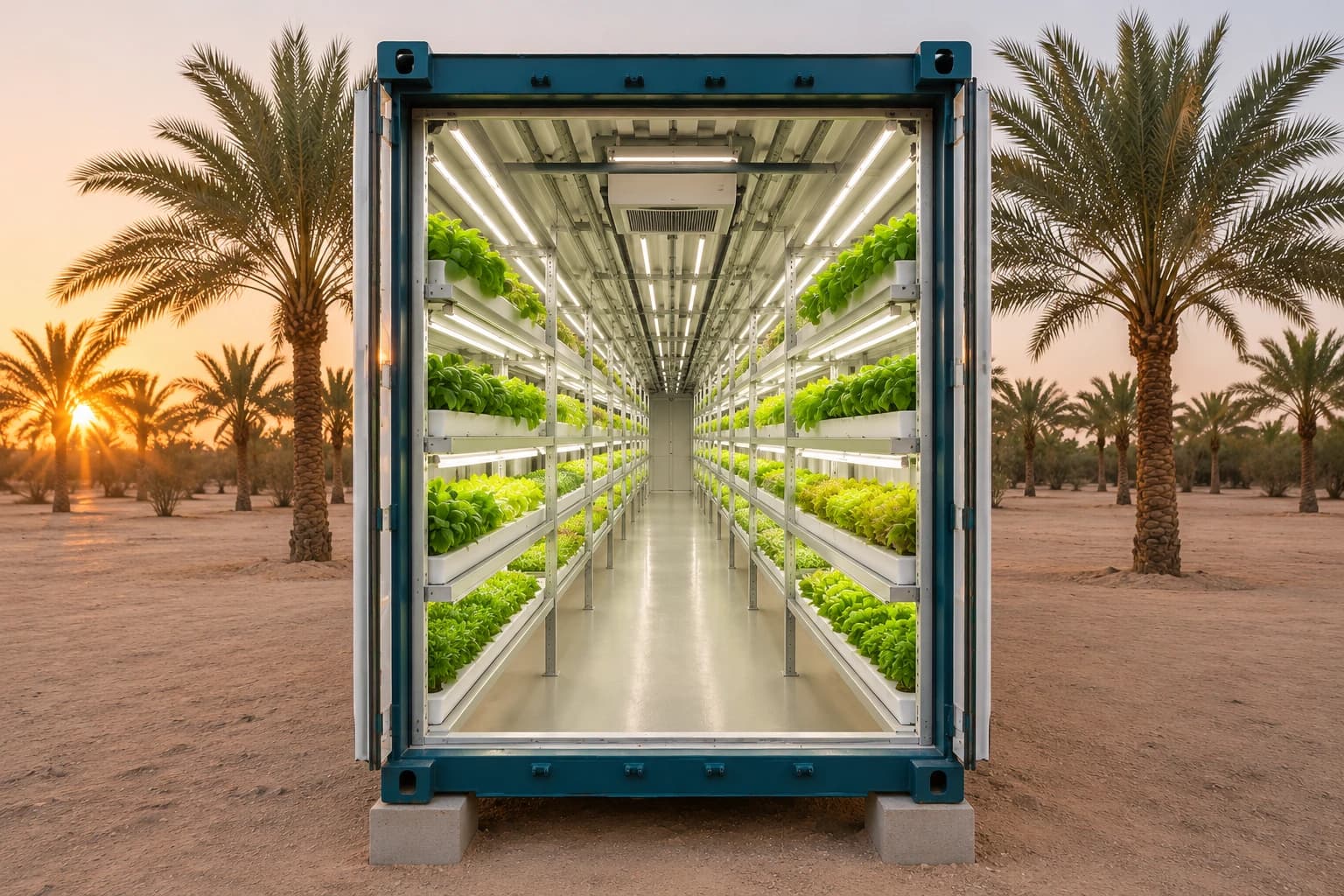
- Container farm setup and operationContainer farms from first ideas to running one: what is inside, planning, site, power, water and safety, daily work, and the real numbers and risks.0/37
- Costs and profitCost types, margins, break-even, cash flow, prices, loans, investment tests and risk checks for a farm business, with worked examples and honest doubts. Not financial advice.0/49
- Solar and electricity for farmskW and kWh, load lists, how panels work, sizing panels and batteries, inverters and the grid, Gulf heat and dust, cleaning, bills and saving power.0/53
Interactive models
Each model sits inside a lesson. Move a control and the values change; every number comes from the lesson's sources.
- Shelf area from floor areaIndoor farming basics · Vertical farms: layers under lamps
- Container floor areaIndoor farming basics · Buildings, containers, shops and homes
- Electricity cost per kiloIndoor farming basics · Why not wheat and rice?
- Run an NFT channelIndoor farming basics · Ways to grow without soil
- Power to cool the lamps' heatIndoor farming basics · Where the electricity goes
- Work out a daily light totalIndoor farming basics · Measure light: the daily total
- Light needed for a targetIndoor farming basics · Work backwards from a daily light total
- Find the VPDIndoor farming basics · Air moisture: work out the VPD
- Sow a parsley seedSeeds and germination · How deep to sow
- Fill a raftPlanting, step by step · Moving seedlings to their final place
- Pollinate a tomato clusterPlanting, step by step · Pollinating flowers by hand
- Pour water on four soilsSoil and growing media · Soil texture: sand, silt and clay
- Turn the soil pH dialSoil and growing media · Soil pH and salt (EC)
- How far from the lamp?Light and LEDs · Lamp distance and light colour
- Watch a bag coloniseMushrooms · Spawn run to harvest, day by day